
Breathedge 2 Crafting and DIY
Turn wreckage into tools, then bolt modules onto those tools until they look illegal.
Crafting is the sequel’s loudest mechanical upgrade. The first Breathedge was already a junk symphony. Breathedge 2 wants scavenging to mean something: you dismantle what you find, learn blueprints, and then DIY-mod the result. Developer posts called this out after the 2025 demo dumped too many gizmos on players and hid a thin loop. The rebuild focused on survival, exploration, and a module system for tools, outfits, and contraptions.
If you only wanted recipes, open the Encyclopedia in-game. This page is the priority list: what to craft, what to ignore, and how the upgrade card actually works. Pair it with resources and tools.
Blueprints, not a giant crafting grid
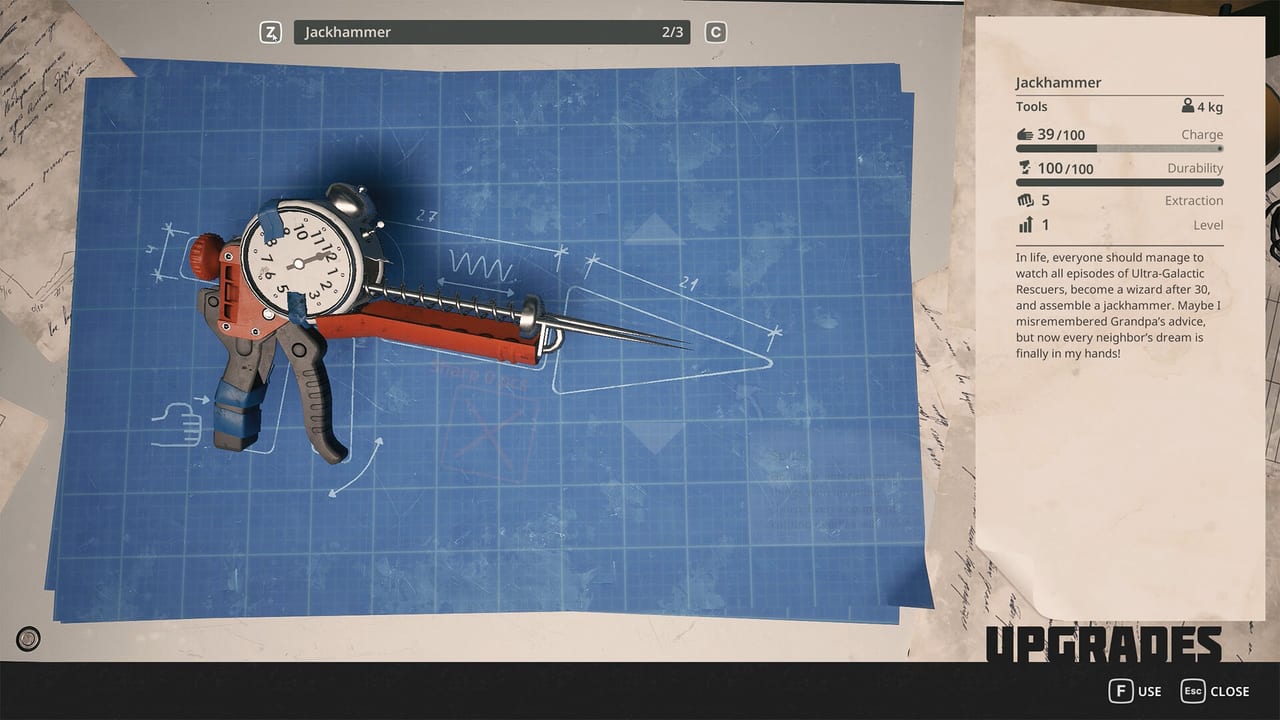
You learn schemes by inspecting the world: broken machines, manuals, corpses, and the occasional quest reward. The upgrade screen in Steam screenshots is a blueprint table. A jackhammer sits on graph paper with charge 39/100, durability 100/100, extraction 5, level 1, and a 4 kg weight. That card is the language of the system:
- Charge is the battery. Zero charge means the tool is a prop.
- Durability is wear. Do not confuse it with charge.
- Extraction (and similar stats) is why you upgrade instead of crafting a second copy.
- Level is the DIY ladder. Modules push this.
- Weight hits carry capacity. A 4 kg toy is fine. Five of them are not.
The funny flavor text on that jackhammer card is the series being itself. Read it, then look at the numbers.
DIY modules
RedRuins described a unique DIY layer: you take a standard tool or suit piece and bolt modules onto it for the benefit you actually need. That is how Breathedge 2 tries to feel closer to a long-term survival craft loop without becoming a spreadsheet. Practical translation:
- Slot a tank or filter when you are about to EVA far. See spacesuit.
- Slot extraction or charge when you are mining a wreck, not sightseeing.
- Slot the extra hand when a job is clearly a two-object puzzle. Developer footage is titled “Extra hand included” for a reason.
- Do not fill every slot with joke items. Posters were a demo meme. They are not a build.
Watch the crafting short in the middle of this page for the intended cadence: inspect, learn, assemble, immediately use. If a recipe feels like a gag, it still probably has a use. The first game hid progress behind absurd objects. The sequel will too. The Encyclopedia is how you tell a gag from a key.
What to build in the opening chapter
Early Access is the first story chapter. You do not need a factory. You need a kit:
- A melee or pry tool (crowbar-class) for doors, panels, and the occasional Coffinbot. Walkthrough jobs often start with “open this.”
- A ranged or spray tool (Spraytron-class) with a known recharge loop. Free station reloads beat crafted cells. Details on tools.
- A gathering tool (jackhammer or drill-class) once extraction jobs appear.
- Suit modules for oxygen and carry, not cosmetics. Survival first.
- Water and food gear as soon as those meters appear. Do not wait for a boss.
Dismantle machines you cannot use. The whole point of the sequel’s scavenging is parts, not a museum. If an object highlights as salvage, it is probably the resource you are short on.
Materials without the hoarder brain
Plastic is common: pipes, suitcases, interior clutter. Titanium was a demo bottleneck behind Chuck’s Taxi, and you did not need much of it to finish that slice. Aluminum showed up in the demo loot table. Duct tape is both a joke and a real consumable. When a quest names a rare, go to the landmark, do not vacuum the whole map.
Keep a trash policy: if it is a poster, a duplicate gadget, or a 2 kg souvenir with no Encyclopedia flag, dump it at the last interior. Your future EVA boost will thank you.
What crafting is not, yet
Base building is on the roadmap, not a day-one pillar. Personal spacecraft, warp jumps, and planetary bases are later. If you are waiting to “set up a mega base” in the first week of Early Access, you will be waiting on a major update. Craft equipment, not architecture, until the developers ship building.
When a recipe confuses you, check the Encyclopedia, then this page, then items. When a job wants a gadget you have never seen, the walkthrough will name the landmark, not a secret vendor. Breathedge 2 crafting is solved when your backpack looks like a toolbox instead of a garage sale.
Frequently Asked Questions
Quick answers to the most common questions.
How does Breathedge 2 crafting differ from the first game?
You dismantle more, learn blueprints, and bolt DIY modules onto tools and the suit instead of only unlocking a flat list of gag items.
What should I craft first?
A pry tool, a rechargeable ranged tool, then survival modules for oxygen and carry. Food and water gear as soon as those meters appear. See survival.
Why is my tool not working?
Check charge and durability on the upgrade card. They are separate bars. Recharge at stations when you can. Details on tools.
Is there base building at Early Access launch?
The developers listed building as a later part of the game, not a launch pillar. Early Access focuses on the Man in open space: loot, craft, repair, quests. See the roadmap.